Luxury Wine & Spirits Collecting: The Complete Guide
Luxury wine and spirits collecting guide: how to evaluate investment-grade Bordeaux, Burgundy, Champagne and rare whisky, plus auctions, storage and returns.…
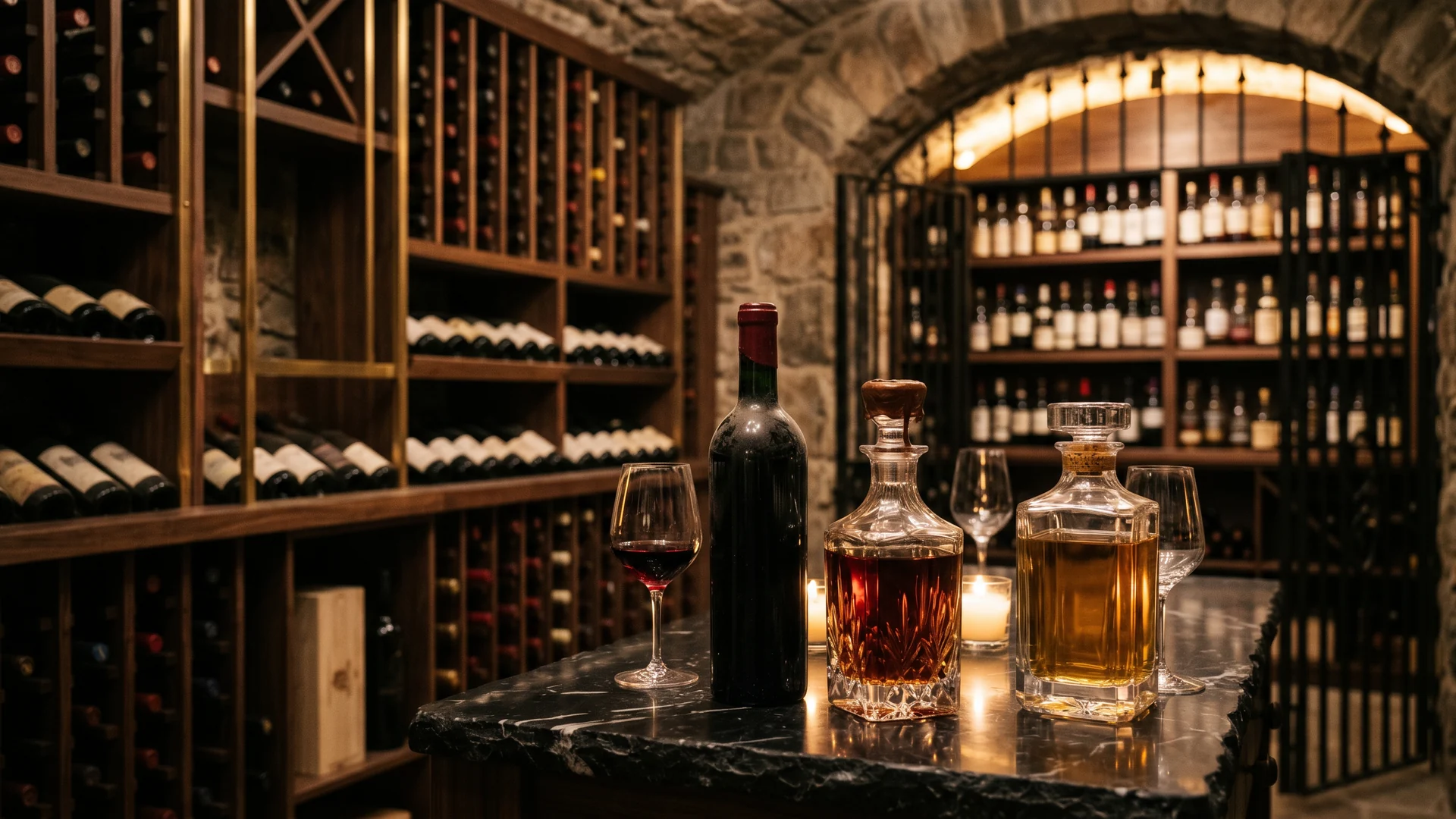
Luxury wine and spirits are top-performing alternative assets, with the Liv-ex Fine Wine 1000 returning over 10% annually and rare Scotch gaining 580% in a decade.
Key Takeaways
- The global fine wine market exceeded $400 billion in 2024, and the Liv-ex Fine Wine 1000 Index has delivered annualized returns above 10% over two decades with lower volatility than the S&P 500.
- The Rare Whisky Icon 100 Index gained over 580% in the decade to 2023, while The Macallan 1926 sold at Sotheby's in 2023 for $2.7 million, a world record for any spirit.
- Investment-grade wine is evaluated on a five-factor model: producer pedigree, critical scores, scarcity, provenance and condition, and market liquidity with a clear exit strategy.
- First-growth Bordeaux estates (Lafite Rothschild, Margaux, Latour, Haut-Brion, Mouton Rothschild) and top Burgundy domaines (DRC, Leroy, Roumier, Rousseau) anchor the market, with a case of DRC Romanée-Conti 2015 trading above $200,000.
- Scarcity drives appreciation: DRC produces roughly 5,000bis6,000 cases yearly and Screaming Eagle fewer than 800, versus Château Lafite Rothschild at about 20,000 cases per vintage.
- Proper storage is non-negotiable at 55°F (13°C), 60bis70% humidity, in darkness and stability; bonded facilities like Octavian hold wine duty- and VAT-suspended at roughly $12, $25 per case annually.
- Auction buyers pay a 20bis25% buyer's premium on top of the hammer price, so a $10,000 bottle actually costs $12,000, $12,500, led by Sotheby's, Christie's, Zachys, and Acker Merrall & Condit.
🌐 Also available in: Español · Français
For centuries, fine wine and rare spirits have represented far more than mere indulgence, they constitute one of the world’s most compelling alternative asset classes, combining tangible luxury with remarkable investment potential. The global fine wine market exceeded $400 billion in 2024, with investment-grade labels consistently outperforming traditional equities during periods of economic uncertainty. The Liv-ex Fine Wine 1000 Index, the industry’s leading benchmark, has delivered annualized returns exceeding 10% over the past two decades, outpacing the S&P 500 with significantly lower volatility. Single-malt Scotch whisky has proven even more spectacular: the Rare Whisky Icon 100 Index posted gains of over 580% in the decade leading to 2023, making it the best-performing collectible asset of the modern era.
This comprehensive guide distills decades of expertise from auction houses, master sommeliers, cellar managers, and portfolio strategists into one authoritative resource. Whether you are acquiring your first case of classified-growth Bordeaux or refining a seven-figure cellar, the principles that follow will serve as your compass through the multifaceted world of luxury wine and spirits collecting.
Investment-Grade Wines
Not all fine wine qualifies as investment-grade. The distinction rests on a confluence of measurable criteria: producer reputation, critical acclaim, scarcity, proven ageing potential, and, critically, liquidity in the secondary market. The most reliable framework for evaluating any wine’s investment credentials is the five-factor model refined by merchants and auction specialists over decades.
Producer Pedigree
A domaine’s or château’s track record is the single most powerful predictor of long-term value appreciation. First-growth Bordeaux estates. Château Lafite Rothschild, Château Margaux, Château Latour, Château Haut-Brion, and Château Mouton Rothschild, have demonstrated century-long arcs of price growth. In Burgundy, the hierarchy is equally rigid: Domaine de la Romanée-Conti (DRC), Domaine Leroy, Domaine Georges Roumier, and Domaine Armand Rousseau occupy the apex. In Champagne, prestige cuvées from Krug, Dom Pérignon, Salon, and Bollinger dominate the investment conversation. The key is consistency across vintages: a producer whose weaker years still command respect is a safer harbour than one whose reputation oscillates.
Critical Scores and Their Market Impact
Robert Parker’s Wine Advocate 100-point scale remains the lingua franca of wine investment, though its influence has been meaningfully diluted by the rise of Antonio Galloni’s Vinous, Jancis Robinson, James Suckling, and the market-savvy scores from Wine Spectator. A single-point difference in the 95bis100 range can translate into a 20bis40% price delta. Wines scoring 98 points or higher from Parker, particularly Bordeaux en primeur releases, see immediate secondary-market premiums of 30% or more. However, sophisticated investors now triangulate across multiple critics; a wine scoring 97+ from at least three independent reviewers carries the most robust investment signal.
Scarcity and Production Volumes
Scarcity is the engine of price appreciation. DRC produces approximately 5,000bis6,000 cases annually across its entire range; Screaming Eagle fewer than 800 cases. Contrast this with Château Lafite Rothschild at roughly 20,000 cases per vintage, and you begin to understand why top Burgundies have outpaced Bordeaux in recent years. But beware of false scarcity: some producers deliberately restrict allocations to create artificial demand. Genuine scarcity, driven by tiny vineyard holdings and low-yielding old vines, is far more durable as a value driver. Production volumes have become especially relevant in Champagne, where the best têtes de cuvée are often released in quantities under 5,000 bottles globally.
Provenance and Condition
Two identical bottles of 1982 Château Pétrus can diverge in value by 50% or more based solely on provenance and physical condition. The gold standard is ex-château or ex-domaine release, followed by single-owner cellars with documented temperature-controlled storage histories, then reputable merchant cellars. Auction houses now employ dedicated provenance specialists who trace bottles through ownership chains. Physical indicators, ullage (fill level), capsule condition, label integrity, and evidence of seepage, must be meticulously assessed. A bottle with a fill level into the neck commands a significant premium over one showing shoulder or, worse, low-shoulder levels, which may indicate oxidation risk.
Market Liquidity and Exit Strategy
Investment-grade wine must be sellable. The most liquid wines trade on the Liv-ex platform, which functions as a regulated exchange with transparent bid-offer spreads. First-growth Bordeaux and top Burgundies typically boast spreads under 10%, while niche categories, aged Rioja, super-Tuscan icons, top Australian Grange, may trade at 15bis25% spreads. Investors should maintain diversified holdings weighted toward liquid segments and anticipate a minimum holding period of five to seven years. The most successful portfolios begin with the exit in mind: every purchase should be evaluated against the question, “Who will buy this from me, and at what cost?”
Bordeaux & Burgundy Deep Dive
The Bordeaux: Burgundy axis constitutes approximately 70% of fine-wine trading volume globally, yet these two regions operate under fundamentally different economic and viticultural paradigms. Understanding their contrasts is essential for any collector.
The Bordeaux Classification System
The 1855 Classification of the Médoc, commissioned by Napoleon III for the Paris Exposition, remains, remarkably, the primary reference for Bordeaux investment nearly 170 years later. Its five-tier hierarchy (Premier Cru through Cinquième Cru) was based on historical market prices and has proven astonishingly durable, with only one substantive change: the elevation of Château Mouton Rothschild to first-growth status in 1973. The Right Bank operates under the separate Saint-Émilion classification, which is reviewed roughly every decade and includes the elite Premier Grand Cru Classé A tier occupied by Château Cheval Blanc, Château Ausone, Château Pavie, and, recently, Château Figeac.
Investment-grade Bordeaux rewards the long view. The finest vintages, 1945, 1947, 1959, 1961, 1982, 1989, 1990, 2000, 2005, 2009, 2010, 2015, 2016, and the exceptional 2018 and 2019, are marvels of longevity, with top labels drinking beautifully at 40, 50, or even 60 years of age. The en primeur system, whereby futures are purchased while the wine is still in barrel, offers below-release pricing but introduces risk: critics’ scores can shift between barrel samples and bottled wines, and global economic conditions can erode premiums. The 2023 en primeur campaign demonstrated this volatility vividly, with some estates cutting release prices by 20bis30% relative to the highly priced 2022 vintage.
Burgundy’s Terroir-Driven Hierarchy
Burgundy’s classification system is radically different, rooted in the concept of terroir, the unique intersection of soil, microclimate, and exposition that defines each parcel. Grand Cru sits at the apex (33 vineyards, representing roughly 1% of total Burgundy production), followed by Premier Cru, village-level wines, and regional Bourgogne. Yet even this hierarchy understates the complexity: within a single grand cru, say, the 50.2-hectare Clos de Vougeot, quality and price vary enormously depending on the producer and precise location within the vineyard wall.
The Burgundy market has undergone a seismic transformation since 2015. Prices for the top domaines, DRC, Leroy, Roumier, Rousseau, Coche-Dury (for whites), have appreciated at rates that make Bordeaux look pedestrian. A case of DRC Romanée-Conti 2015 now routinely trades above $200,000 at auction, while Domaine Leroy Musigny can exceed $40,000 per bottle in top vintages. This escalation has reshaped the market: Asian and American collectors dominate buying, traditional European collectors have been partially priced out, and the secondary market now demands near-perfect provenance. Counterfeiting has become a serious concern; collectors are advised to purchase only through merchants and auction houses that employ forensic authentication, including ultraviolet light examination, paper and ink analysis, and cork-brand verification.
Comparative Investment Dynamics
Bordeaux offers depth, liquidity, and lower volatility. Burgundy offers scarcity, spectacular upside, and significantly higher risk. A balanced portfolio typically allocates 50bis60% to Bordeaux as the foundation, 20bis30% to Burgundy for growth, and the remainder to Champagne, Italy, California, and emerging regions. The most disciplined collectors treat Burgundy positions as high-conviction bets, concentrated in fewer names with longer intended hold periods, while managing Bordeaux as a more tactical, tradeable allocation.
Champagne & Sparkling
Champagne has completed its transition from celebration accessory to serious investment asset, with the Champagne 50 Index posting five-year gains exceeding 60%. The category’s investment thesis rests on three pillars: growing global demand, particularly from Asian markets where Champagne consumption has increased sixfold since 2000; constrained production governed by strict appellation rules; and the remarkable ageing capacity of prestige cuvées, which develop extraordinary complexity over 20bis40 years.
The Investment-Grade Champagne Hierarchy
At the apex sit the têtes de cuvée: Dom Pérignon (especially the P2 and ultra-rare P3 Plénitude releases), Krug Clos du Mesnil and Clos d’Ambonnay (single-vineyard blanc de blancs priced from $3,000 per bottle), Salon Le Mesnil (produced only in exceptional years, a mere 41 vintages since 1905), Bollinger Vieilles Vignes Françaises (from ungrafted pre-phylloxera vines), and the newly emergent Jacques Selosse Substance (a solera-system Champagne that has developed a cult following).
Large-format bottles carry a structural premium. A jeroboam (3 litres) of Krug Clos du Mesnil typically commands 2.5bis3x the per-litre price of a standard 750ml bottle, while a methuselah (6 litres) can command 4bis6x. These formats age more slowly and gracefully, making them particularly attractive for multi-decade holdings. The market for large-format prestige Champagne is so thin and coveted that auction houses often build entire sales around single collections of large bottles.
Beyond Champagne: Global Sparkling
The sparkling wine investment universe extends well beyond Champagne’s borders. Franciacorta from Lombardy, particularly the Riserva expressions from Ca’ del Bosco and Bellavista, has gained meaningful auction presence. English sparkling wine, led by Nyetimber, Gusbourne, and Ridgeview, is an emerging category watched carefully by investors, driven by climate change and chalk soils identical to Champagne’s. Tasmanian sparkling from the cold-climate southern island of Australia, especially House of Arras and Jansz, represents another nascent but credible investment category. These alternatives trade at fractions of equivalent Champagne prices, offering asymmetric upside if their reputations continue to ascend.
Whisky & Spirits Collecting
The rare spirits market has exploded from a niche enthusiast pursuit to a multi-billion-dollar asset class in under fifteen years. Single-malt Scotch whisky leads the charge, but the category now encompasses Japanese whisky, vintage Cognac, aged rum, and even rare tequila and mezcal. The Rare Whisky Apex 1000 Index, which tracks the 1,000 most collectible bottles, illustrates the scale of transformation: what was an $80 million market in 2010 surpassed $800 million by 2023.
Single-Malt Scotch: The Blue-Chip Standard
Scotch whisky collecting is anchored by a handful of legendary distilleries, each with its own investment profile. The Macallan dominates both mindshare and prices: a bottle of The Macallan 1926 (with a label designed by Sir Peter Blake) sold at Sotheby’s in 2023 for $2.7 million, setting the world record for any spirit. Beyond The Macallan, the most sought-after names include Port Ellen (the silent Islay distillery whose remaining stocks grow more valuable by the year), Brora (another silent distillery, revived in 2021 but with pre-closure stocks commanding fortunes), Bowmore (particularly the mythical Black Bowmore trilogy), Dalmore (the Constellation and Paterson collections), and Springbank (the cult Campbeltown distillery whose limited allocations vanish instantly).
Investment-grade Scotch is typically defined by three attributes: age statement (25 years and above as a rule of thumb, though quality trumps age), cask type (first-fill sherry casks consistently deliver the highest auction prices), and distillery reputation. Independent bottlers, particularly Gordon & MacPhail, Samaroli, and the Scotch Malt Whisky Society, add a layer of connoisseurship, as their selections often represent single casks never replicated.
Japanese Whisky and the Scarcity Premium
Japanese whisky has been the defining spirits story of the past decade. The category nearly collapsed in the early 2000s, leading distilleries to slash production, creating a catastrophic supply-demand imbalance when global recognition arrived. Karuizawa, a distillery demolished in 2011, has become the holy grail: a single bottle of Karuizawa 1960 sold for over $600,000. Yamazaki, particularly the Sherry Cask expression, and Hibiki aged statements from 17 to 30 years now trade at multiples of Scotch equivalents. The market has cooled modestly from its 2021bis2022 peak, but Suntory’s disciplined approach to production suggests supply will remain constrained for at least another decade, underpinning long-term value.
Cognac, Armagnac, and Rum
Vintage Cognac, produced only in exceptional years from a single harvest, represents the most undervalued segment of the spirits market relative to its quality, age, and rarity. Houses like Rémy Martin (the Louis XIII Rare Cask series), Hennessy (the Paradis and Richard lines), and Hine (the Triomphe and vintage-dated expressions dating to the 19th century) offer bottles that have aged 50bis100 years at prices that pale beside equivalent-age Scotch. Armagnac, Cognac’s older and more artisanal cousin, remains almost entirely overlooked by speculators, presenting what many connoisseurs consider the greatest buying opportunity in spirits today. In the rum category, closed distilleries, particularly Caroni from Trinidad and the Demerara stills of Guyana, have generated extraordinary returns, with rare Caroni bottlings appreciating 300bis500% in five years.
Understanding Wine Auctions
The auction room is where wine’s status as a financial asset is most nakedly revealed. Global fine wine and spirits auction sales exceeded $1.2 billion in 2024, led by Sotheby’s, Christie’s, Zachys, and Acker Merrall & Condit. Understanding auction mechanics, from bidding strategies to the hidden costs embedded in buyer’s premiums, is essential for any collector who plans to acquire or divest at scale.
The Auction Ecosystem
Major auction houses operate on a commission model: sellers pay a negotiated vendor’s commission (typically 0bis10%, with zero for truly exceptional collections), while buyers pay a buyer’s premium, usually 20bis25% of the hammer price, added on top of the winning bid. This premium structure means that a bottle hammering at $10,000 actually costs the buyer $12,000, $12,500. Sophisticated bidders internalize this math, setting their maximum paddle price 20% below their true ceiling. Online platforms like WineBid and Spectrum Wine have democratized access, offering lower premiums (typically 15bis17%) and eliminating geographic barriers, though they lack the discovery and excitement of live salerooms.
Bidding Strategies
Successful auction buying demands discipline, preparation, and emotional detachment. The cardinal rule is to establish a firm maximum bid before the auction begins, based on recent comparable sales, current market conditions, and your own valuation model, and never exceed it. Absentee (or commission) bids, placed in advance, remove the temptation of last-minute auction fever. Most professionals avoid live bidding entirely for this reason, submitting detailed commission instructions instead. For those who do bid live, the most effective tactic is to open at or near the low estimate and bid decisively in even increments, projecting confidence that can deter competitors. Hesitation telegraphs vulnerability and invites aggression.
Provenance Verification and Due Diligence
Auction catalogues are meticulously prepared but not infallible. Collectors should independently verify fill levels (requesting photographs if the catalogue lacks them), scrutinize capsule conditions for evidence of heat damage or tampering, and investigate the consignor’s identity where possible. The most trustworthy lots carry a clear chain of custody: purchased en primeur, stored at Octavian or another bonded warehouse, and consigned directly by the original owner. Lots with ambiguous histories, multiple ownership transfers, or storage in private cellars without independent verification warrant deeper investigation, and proportionally lower bids. Some auction houses now employ blockchain-based provenance tracking, and these lots reliably attract premiums.
Storage & Cellar Management
Storage is the silent determinant of wine investment returns. A perfectly purchased portfolio stored improperly can lose 80% of its value before a single bottle is opened. The science of wine storage is settled and non-negotiable, yet violations are distressingly common, even among experienced collectors.
The Non-Negotiable Parameters
Temperature is the paramount variable. The universally accepted target is 55°F (13°C), with a tolerance of ±2°F. Temperatures above 68°F (20°C) accelerate ageing reactions exponentially, the Arrhenius equation suggests that every 18°F (10°C) increase doubles the rate of chemical degradation. Equally important is temperature stability: fluctuations of even 5°F cause the wine to expand and contract within the bottle, compromising the cork’s seal and permitting oxygen ingress. Humidity should be maintained at 60bis70% to prevent cork desiccation without encouraging mould. Light, particularly ultraviolet radiation, is wine’s enemy, which is why dark glass and cellar darkness are essential. Vibration, often overlooked, disturbs sediment and accelerates chemical reactions; cooling units and nearby machinery must be isolated.
Professional Storage Solutions
For investment-grade collections, professional bonded storage is the standard, not the exception. Facilities like Octavian (in Wiltshire, England), London City Bond, and Domaines et Châteaux in France offer military-grade security, redundant climate-control systems, and, critically, bonded status, meaning wines are held under customs suspension and exempt from duty and VAT until withdrawn for consumption. This is not a luxury but a financial necessity: bonded storage preserves the wine’s value for international sale without triggering tax liabilities that can reach 30bis40% in some jurisdictions.
Annual storage costs run approximately $12, $25 per case in bonded facilities, a negligible expense relative to the value appreciation of properly cellared wines. The leading facilities also provide integrated digital inventory management, photographic condition reports, and seamless auction consignment. Collectors holding 50 cases or more should strongly consider bonded storage for the entire collection. For smaller home cellars, purpose-built cooling units from EuroCave, Liebherr, and ArteVino offer professional-grade temperature and humidity control in self-contained cabinets, though they cannot replicate the provenance advantages of bonded facilities.
Inventory Management and Cellar Software
Digital cellar management has evolved from spreadsheets into sophisticated platforms. CellarTracker, the market leader with over 10 million wines catalogued, provides community-sourced drinking windows, current market valuations via Liv-ex integration, and barcode-based bottle tracking. InVintory and VinoCell offer similarly polished interfaces with a focus on mobile-first design. For professional collectors, VinCellar integrates directly with bonded warehouses and generates tax reports for international holdings. The discipline of maintaining an accurate digital inventory is non-negotiable for any collector holding more than 100 bottles, without it, the optimal drinking window for peak-value wines is inevitably missed.
Wine Regions Guide
While Bordeaux and Burgundy command the lion’s share of investment attention, a sophisticated collector’s geographic map extends much further. The following regions represent the most important, investable, and rapidly evolving wine-producing areas beyond the traditional French core.
Italy: Tuscany and Piedmont
Italy is wine investment’s second market, with Tuscany’s Brunello di Montalcino and Bolgheri super-Tuscans, alongside Piedmont’s Barolo and Barbaresco, delivering compound annual returns of 8bis12% over recent decades. The market for top producers. Sassicaia, Masseto, Tignanello, and Ornellaia in Tuscany; Giacomo Conterno, Bruno Giacosa, and Gaja in Piedmont, has deepened substantially, with Liv-ex now maintaining dedicated Italy indices. The 2016 Barolo vintage, released to near-universal acclaim, is widely considered the finest since 2010 and represents a compelling entry point for investors who have not yet allocated to Piedmont.
California: Napa and Sonoma
California’s fine wine market has matured dramatically. Screaming Eagle, Harlan Estate, and Bond lead the investment-grade tier, with prices that rival first-growth Bordeaux. The 2013, 2015, 2016, 2018, and 2019 Napa vintages are considered modern benchmarks. Ridge Monte Bello, from the Santa Cruz Mountains, occupies a unique position as California’s most Bordeaux-like wine with a 50-year track record of ageability. Cult Cabernets, Colgin, Bryant Family, Abreu, and Schrader, command fierce loyalty among American collectors, though their international liquidity is more limited. For investors seeking undervalued opportunities, the rising reputations of Rhys, Littorai, and Ceritas in Sonoma’s cool-climate Pinot Noir and Chardonnay merit attention.
Spain, Australia, and Emerging Regions
Spain’s investment story is dominated by Vega Sicilia: specifically the Unico Gran Reserva, which ages for a minimum of ten years before release and consistently trades at the level of classified Bordeaux, and the Priorat wines of Álvaro Palacios (particularly L’Ermita) and Clos Erasmus. In Australia, Penfolds Grange remains the standard-bearer, with the 2010 vintage now trading at over $900 per bottle. Henschke’s Hill of Grace, Torbreck’s The Laird, and the icon Shiraz wines from Chris Ringland represent the next tier of Australian collectibles. Emerging regions offering asymmetric upside include South Africa’s Swartland revolution (led by Eben Sadie and Mullineux), Chile’s coastal Pinot Noir (particularly from the Limarí and Itata valleys), and the single-vineyard Malbec crus of Argentina’s Uco Valley, especially from the Catena family’s Adrianna Vineyard.
Tasting & Appreciation
Investment returns are only half the equation. The singular joy of wine collecting, and the dimension that distinguishes it from equities or real estate, is the sensory experience of opening a perfectly cellared bottle at its peak of maturity. Developing a structured approach to tasting transforms collecting from asset accumulation into a lifelong pursuit of knowledge and pleasure.
The Systematic Tasting Method
The Wine & Spirit Education Trust (WSET) Systematic Approach to Tasting (SAT) provides the most widely adopted framework, progressing through appearance (clarity, intensity, colour, rim variation), nose (condition, intensity, aroma characteristics), palate (sweetness, acidity, tannin, alcohol, body, flavour intensity, flavour characteristics, finish), and conclusion (quality level, readiness for drinking, potential for ageing). The Court of Master Sommeliers’ deductive tasting format is more rigid and time-pressured, designed for blind identification rather than appreciation. For collectors, the WSET approach is more useful: it builds a vocabulary for describing and, crucially, remembering wines, enabling comparative analysis across vintages, producers, and decades.
Building a Palate for Investment Decisions
The ability to assess a wine’s ageing trajectory from a young sample is an enormously valuable skill for en primeur buyers and portfolio managers. Key indicators include tannin structure, are the tannins fine-grained and integrated, or coarse and aggressive? acidity, which is the backbone of longevity, and fruit concentration relative to structural elements. Wines that appear tightly wound, even austere, in youth often possess the greatest ageing potential. The classic error is mistaking immediate charm for long-term quality; many of history’s greatest wines, the 1961 Latour, the 1978 DRC Romanée-Conti, were forbiddingly tannic in their first decade. Regular attendance at trade tastings, verticals hosted by auction houses, and producer visits accelerates palate development exponentially.
Glassware, Decanting, and Service
At the highest levels, glassware is not ceremonial but functional. The shape of a glass determines how aromatics reach the nose, with different designs optimized for different grape varieties. Zalto’s Denk’Art series has become the collector’s standard for its ultra-thin, lead-free crystal that heightens aromatic expression. For decanting, rules are vintage-specific: young, tannic wines benefit from extended aeration (2bis6 hours), while older, fragile wines (25+ years) should be decanted gently off their sediment immediately before serving to avoid stripping delicate aromatics. The most rigorous collectors maintain detailed service notes, recording decanting duration, serving temperature, and glassware used, variables that profoundly affect the tasting experience and the perceived quality of the wine.
Building a Portfolio
A disciplined approach to portfolio construction separates successful wine investors from enthusiastic accumulators. The principles that follow, drawn from conversations with the world’s leading wine fund managers, apply whether you are deploying $50,000 or $5 million.
Core: Satellite Architecture
The most robust wine portfolios adopt a core: satellite structure analogous to institutional equity management. The core (50bis60% of capital) consists of highly liquid, blue-chip wines: first-growth Bordeaux, top negociant Burgundy, prestige Champagne, and investment-grade super-Tuscans. This core provides stability, reliable appreciation, and rapid exit capability. The satellite (40bis50%) is divided into growth allocations, emerging producers, undervalued regions, and younger vintages with asymmetric upside, and speculation, typically limited to 10bis15% and focused on nascent categories like English sparkling, cult Napa, or aged spirits from emerging regions.
Diversification Across Dimensions
Wine portfolio diversification operates across multiple axes. Geographic diversification reduces exposure to vintage-specific disasters (frost, hail, smoke taint), which are typically regional rather than global. Vintage diversification smooths returns and ensures a steady supply of wines entering their peak drinking window. Producer diversification within each region mitigates reputational risk. Format diversification, mixing standard bottles with magnums and larger formats, provides both a structural premium on large formats and greater liquidity on standard sizes. The optimal portfolio typically holds 80bis120 distinct lines, with no single wine exceeding 5% of total value.
Entry and Exit Discipline
Wine investments should never be entered without an exit thesis. En primeur purchases work best when the vintage is excellent but market sentiment is cautious, the 2019 Bordeaux campaign, which coincided with pandemic uncertainty and saw first-growth releases priced 20bis30% below the 2018 vintage, represents a textbook case. Secondary-market buying is most effective during broader market dislocations; the Liv-ex 1000 fell 13% during 2023bis2024 as interest rates rose, creating attractive entry points for disciplined investors. On the exit side, selling into strength, when a particular category or vintage attracts disproportionate media and trade attention, consistently outperforms forced sales. The most elegant exit strategy is to consume a portion of the portfolio at peak maturity while trading the remainder, extracting both financial and experiential returns.
Insider Tips
What follows are the unvarnished insights shared by auction house specialists, master of wine portfolio managers, and veteran collectors, the knowledge that separates seasoned professionals from well-funded amateurs.
Never Buy Wine You Would Not Drink
This single rule, repeated by every serious collector interviewed for this guide, is the ultimate hedge. Wine markets can turn, the Bordeaux crash of 2011bis2014 erased over 40% of peak valuations, and when they do, the ability to derive genuine pleasure from your holdings transforms a financial loss into an acceptable outcome. Moreover, conviction in the wine’s quality makes it far easier to hold through temporary dislocations. The investors who panicked and sold Pétrus 1990 at a loss in 2014 missed its subsequent recovery to new all-time highs by 2018.
Build Relationships with Merchants
Allocation of the world’s most sought-after wines, Screaming Eagle, DRC, the top Grower Champagnes, is not a transaction but a relationship. Merchants allocate their most coveted parcels to customers who have demonstrated loyalty, patience, and a genuine interest in wine beyond investment. This means buying across a merchant’s entire portfolio, not cherry-picking only the blue-chip allocations, and occasionally buying wines that may underperform financially but build goodwill. The collectors who consistently receive allocations of DRC do not call their merchants only when the market is hot; they call to share notes on a recently opened bottle and to inquire about the merchant’s own recent discoveries.
Buy in Multiples of Three or Six
The minimum economically rational purchase for investment-grade wine is three bottles: one to drink now (or at maturity), one to hold for later appreciation, and one to sell to cover the cost basis of all three. At six bottles, the economics improve further: two to drink, two to hold, and two to sell. Original wooden cases (OWCs) of 6 or 12 command a premium of 10bis20% over loose bottles and must be kept intact, with the original case, tissue paper, and any supporting documentation, to preserve that premium at resale.
Watch the Critics’ Calendars
Wine critic publications drive market movements with startling regularity. Antonio Galloni’s Vinous typically releases Bordeaux in-bottle reports in February, triggering price adjustments for recently bottled vintages. James Suckling’s annual Top 100 list, released in November, generates immediate buying pressure on featured wines. The Wine Advocate’s Burgundy reviews, published on an unpredictable schedule, can cause single-day price spikes of 15bis25% for upgraded wines. Savvy investors maintain calendars of expected publication dates and position accordingly, either buying ahead of anticipated upgrades or selling into the post-publication enthusiasm.
Understand Tax Implications Before You Buy
Wine taxation is a jurisdictional minefield. In the United Kingdom, wines held in bond are exempt from duty and VAT; withdrawing them triggers rates of £2.97 per bottle plus 20% VAT on both the wine’s value and the duty. In Hong Kong, which abolished wine duties in 2008, the tax-free status has made it Asia’s wine trading hub, with enormous volumes of fine wine imported and stored. In the United States, wine held in third-party storage is typically not subject to state sales tax until withdrawn. Collectors who fail to account for these costs, which can exceed 40% in some jurisdictions, can find their investment returns substantially eroded. Cross-border collectors should consult a specialist wine accountant, as the interaction of bonded storage, import duties, capital gains treatment, and estate planning creates genuinely complex tax positions.
Insure Your Collection Properly
Standard homeowners’ insurance policies typically exclude or severely cap coverage for fine wine. Specialist insurers, AIG Private Client Group, Chubb, and AXA Art, offer policies tailored to wine collections, covering risks including temperature-control failure, breakage, theft, and transit. Premiums typically run 0.3bis0.6% of insured value annually, and insurers require evidence of professional storage conditions and regular professional valuations. Underinsurance is endemic: a collection valued at $500,000 five years ago may now be worth $900,000, rendering legacy coverage dangerously inadequate. Annual revaluation against current Liv-ex trading prices is a minimum standard of prudent collection management.
Document Everything Meticulously
The difference between a well-documented collection and a poorly documented one is measured in real money, typically 10bis20% at auction. Every bottle acquired should generate a digital record including: purchase date, purchase price, source, storage history, any professional condition assessments, and a high-resolution photograph of the bottle (front label, back label, capsule, and fill level). When the time comes to sell, this documentation package should be presented to the auction house alongside the physical wines. Consignors who deliver complete documentation invariably achieve higher hammer prices and attract more enthusiastic bidding. In an increasingly digital and provenance-conscious market, the paperwork is as valuable as the wine.
The world of luxury wine and spirits collecting rewards patience, knowledge, and relationships over speculation and impulse. The finest collections are built over decades, not quarters, and the collectors who thrive are those who approach wine with equal measures of intellectual curiosity, aesthetic appreciation, and financial discipline. The glass raised at the end of a successful collecting journey tastes sweeter than any quarterly statement ever could.
Frequently Asked Questions (FAQ)
How much have luxury wine and rare whisky returned as investments?
The Liv-ex Fine Wine 1000 Index has delivered annualized returns exceeding 10% over the past two decades, outpacing the S&P 500 with lower volatility. Single-malt Scotch has done even better: the Rare Whisky Icon 100 Index posted gains of over 580% in the decade leading to 2023, making it the best-performing collectible asset of the modern era.
What makes a fine wine investment-grade?
Investment-grade status rests on a five-factor model: producer pedigree, critical scores, scarcity, provenance and condition, and market liquidity. The producer's track record is the single strongest predictor of value, while liquidity ensures the wine is sellable. Investors should buy with the exit in mind and anticipate a holding period of five to seven years.
Which Bordeaux and Burgundy producers are the best for collecting?
In Bordeaux, the first growths lead: Château Lafite Rothschild, Margaux, Latour, Haut-Brion, and Mouton Rothschild. In Burgundy, the apex domaines are Domaine de la Romanée-Conti, Leroy, Georges Roumier, and Armand Rousseau. A case of DRC Romanée-Conti 2015 now routinely trades above $200,000 at auction, and Domaine Leroy Musigny can exceed $40,000 per bottle.
Is Champagne a good investment, and which bottles matter most?
Yes. The Champagne 50 Index has posted five-year gains exceeding 60%, driven by rising Asian demand, constrained production, and long ageing capacity. The têtes de cuvée lead: Dom Pérignon, Krug Clos du Mesnil and Clos d'Ambonnay, Salon Le Mesnil, Bollinger Vieilles Vignes Françaises, and Jacques Selosse Substance. Large formats like jeroboams carry structural premiums.
How should luxury wine be stored to protect its value?
Store wine at 55°F (13°C) with a ±2°F tolerance, 60bis70% humidity, in darkness, with stability and no vibration. Improper storage can erase 80% of a portfolio's value. For investment collections, bonded facilities like Octavian, London City Bond, and Domaines et Châteaux hold wine duty- and VAT-suspended for roughly $12, $25 per case annually.
What costs and strategies apply when buying wine at auction?
Buyers pay a premium of 20bis25% of the hammer price on top of the winning bid, so a bottle hammering at $10,000 actually costs $12,000, $12,500. Set a firm maximum bid in advance and never exceed it; many professionals use absentee commission bids to avoid auction fever. Online platforms like WineBid offer lower premiums of 15bis17%.
Which whisky distilleries and spirits are most collectible?
The Macallan dominates prices, with a 1926 bottle selling for $2.7 million in 2023. Other sought-after names include Port Ellen, Brora, Bowmore, Dalmore, and Springbank. Beyond Scotch, Japanese whisky like Karuizawa and Yamazaki commands premiums, while vintage Cognac, Armagnac, and closed-distillery rums such as Caroni offer undervalued opportunities.
How should a collector allocate a balanced fine-wine portfolio?
A balanced portfolio typically allocates 50bis60% to Bordeaux as the liquid, lower-volatility foundation, 20bis30% to Burgundy for scarcity and upside, and the remainder to Champagne, Italy, California, and emerging regions. Bordeaux is managed as a tactical, tradeable allocation, while Burgundy positions are treated as high-conviction bets held longer.
More from Magazine
Luxury Wedding Planning: The Ultimate Guide
Luxury wedding planning guide: top destination venues, couture bridal designers, Michelin catering, headline entertainment and elite planners for a fl…
Luxury Fashion: The Complete Style Guide
The complete luxury fashion style guide: bespoke tailoring, haute couture, heritage maisons like Hermes and Chanel, 2026 trends, investment bags and s…

Gourmet Melbourne: A Taste of Australia’s Culinary Innovations
Melbourne, the capital city of the Australian state of Victoria, has gained a well-deserved reputation as a foodie destination. With its diverse culin…