Watch Collecting & Investment: The Complete Guide
Watch collecting and investment guide: how Rolex, Patek Philippe, Audemars Piguet and Richard Mille hold value, plus complications, auctions and 2026 trends.…
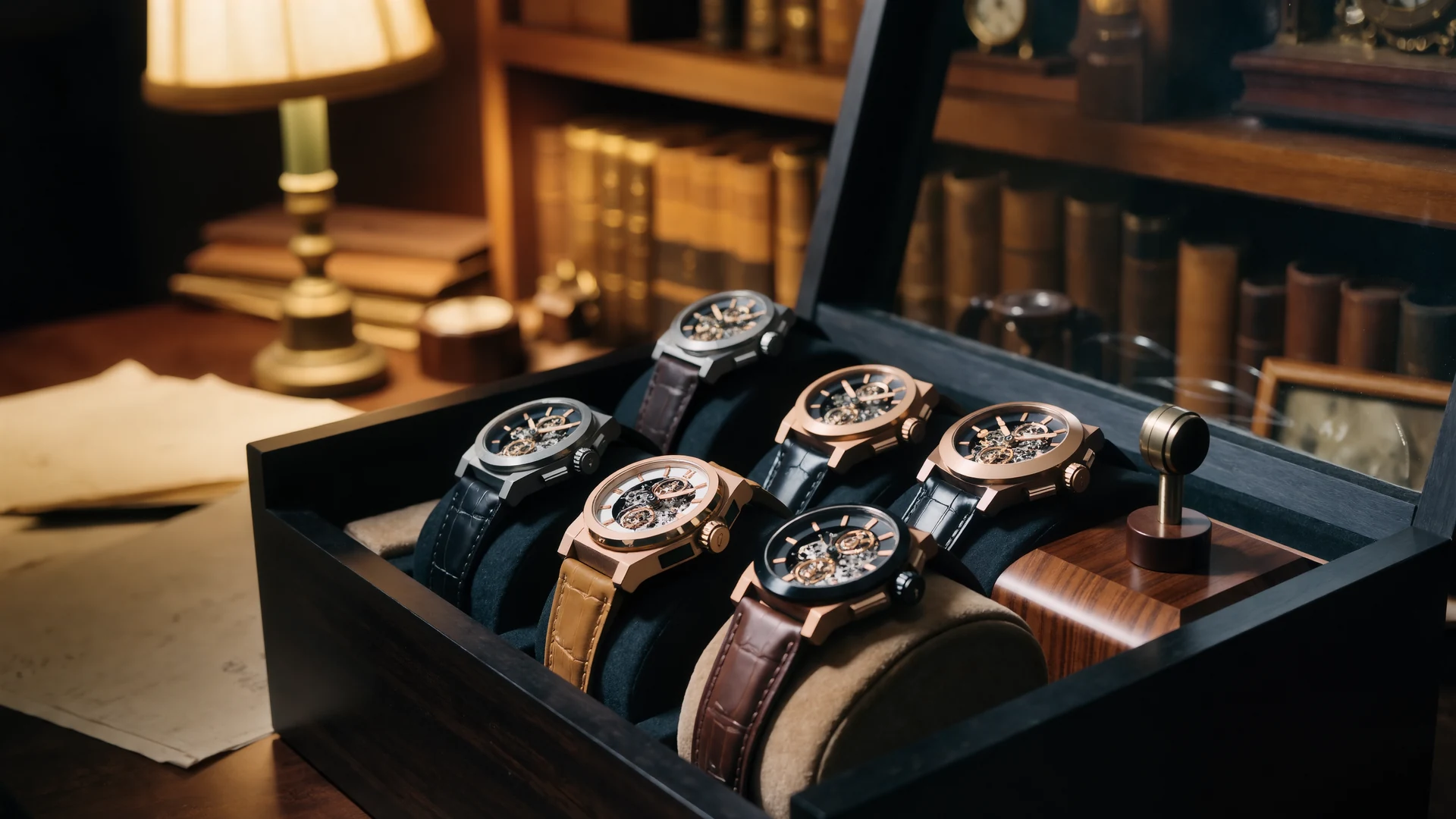
Investment-grade watch collecting centers on a narrow universe of references from Rolex, Patek Philippe, Audemars Piguet and Richard Mille, where scarcity, condition and complications drive long-term value.
Key Takeaways
- The investment-grade segment is narrow, comprising perhaps only a few hundred references across a handful of brands, with certain categories delivering annual returns exceeding 15% per the Knight Frank Luxury Investment Index.
- Four manufacturers dominate the market: Rolex (the liquid blue-chip benchmark), Patek Philippe (the prestige apex), Audemars Piguet (the Royal Oak ecosystem) and Richard Mille (the disruptor).
- Intentional scarcity underpins value: Rolex makes roughly one million watches a year, Patek Philippe about 62,000, Audemars Piguet around 50,000, and Richard Mille only about 5,000.
- Complications drive value non-linearly, rising from date and chronograph through GMT, annual and perpetual calendars to the tourbillon and the minute repeater, where fewer than 100 watchmakers worldwide can build the latter.
- Record auction results show the stakes: a Paul Newman Rolex Daytona sold for $17.8 million in 2017 and a steel Patek Philippe Reference 1518 for CHF 11 million in 2016.
- Condition, originality and provenance are decisive; an original vintage Submariner can be worth three to five times an identical reference with service replacement parts, and a full set of box and papers adds 10 to 30% to modern watches.
- Entering 2026 the market has stabilized after the 2020 to 2022 boom and 2022 to 2024 correction, holding 30 to 50% above pre-pandemic 2019 levels with independents, smaller cases and neo-vintage as growth themes.
🌐 Also available in: Español · Français
Why Watches as Assets
The notion of luxury watches as alternative investments has moved from niche collector circles to the mainstream financial conversation. Over the past decade, select timepieces have outperformed traditional asset classes including equities, gold, and real estate. The Knight Frank Luxury Investment Index has repeatedly ranked watches among the top-performing collectible assets, with certain categories delivering annual returns exceeding 15%.
What makes watches uniquely compelling as an asset class? First, they are tangible, portable stores of value in a world of increasingly digital financial instruments. A Patek Philippe Nautilus or Rolex Daytona can cross borders on your wrist, outside the purview of capital controls or banking restrictions. Unlike art, which requires climate-controlled storage, or classic cars, which need garages and maintenance, a watch vault can hold millions of dollars in a space smaller than a briefcase.
Second, the supply-demand dynamics are structurally favorable. Top-tier manufactures like Rolex, Patek Philippe, and Audemars Piguet deliberately constrain production well below market demand. Rolex produces approximately one million watches annually against global demand estimated at two to three times that figure. This intentional scarcity, combined with multi-year waiting lists at authorized dealers, creates a permanent premium for the secondary market.
Third, watches possess a dual utility rare among investments. They are both financial instruments and objects of daily use and enjoyment. An owner can wear and appreciate a Submariner for a decade while it appreciates in value, an experience no stock certificate or bond can replicate. This “emotional dividend” justifies valuations that might otherwise appear irrational through a purely financial lens.
The market has also matured institutionally. Dedicated watch funds, fractional ownership platforms, and watch-specific auction houses have emerged, providing liquidity, price discovery, and professionalization formerly absent. The Bloomberg Subdial Watch Index now tracks market performance with the rigor once reserved for commodities, giving investors transparent benchmarks for portfolio decisions.
However, not all watches appreciate. The investment-grade segment is narrow, perhaps a few hundred references across a handful of brands. Understanding the boundaries of this universe, the drivers of value, and the pitfalls awaiting the unwary is the purpose of this guide.
Top Investment Brands: Rolex, Patek Philippe, Audemars Piguet & Richard Mille
The investment-grade watch market is dominated by four manufacturers whose models consistently appreciate or at minimum hold value. Understanding each brand’s investment hierarchy is fundamental to building a collection.
Rolex: The Blue-Chip Standard
Rolex is the most liquid and widely traded luxury watch brand globally, functioning as the market’s benchmark. The stainless steel sports models form the investment core: the Daytona (references 116500LN and 126500LN), the GMT-Master II (“Pepsi” 126710BLRO, “Batman” 126710BLNR), and the Submariner (126610LN and the discontinued “Hulk” 116610LV). These references trade consistently above retail, with the Daytona commanding premiums of 80bis120% on the secondary market.
Vintage Rolex constitutes a separate investment category. The Paul Newman Daytona (reference 6239, 6241, 6263) is legendary, one example sold for $17.8 million in 2017. More accessible vintage targets include the Reference 1680 “Red Submariner” (single red line of text), the 1675 GMT-Master with gilt dial, and the 5513 Submariner with meters-first dial. Condition and originality are paramount in vintage; a watch with service replacement parts can be worth 40bis60% less than an untouched original.
Rolex’s investment advantage lies in its global recognition and liquidity. A steel Rolex sports model can be sold within 24 hours in virtually any major city worldwide. The brand’s conservative design evolution ensures that even decade-old models remain aesthetically current, supporting long-term value retention.
Patek Philippe: The Apex Predator
Patek Philippe occupies the summit of watchmaking prestige and, correspondingly, investment performance. The brand’s slogan, “You never actually own a Patek Philippe; you merely look after it for the next generation”, is not merely marketing but investment philosophy.
The Nautilus collection, particularly the reference 5711/1A-010 in steel with blue dial (discontinued in 2021), is the most coveted sports watch in existence. At its peak in early 2022, this model traded above $200,000, roughly seven times its retail price of $34,890. The subsequent reference 5811 in white gold continues the lineage. The Aquanaut (5167A and the chronograph 5968A) offers a slightly more accessible entry into Patek steel sports watches.
For serious collectors, the grand complications represent the ultimate investment tier. Perpetual calendar chronographs (references 3970, 5970, 5270), minute repeaters, and split-seconds chronographs are produced in tiny numbers and command six- and seven-figure prices. The Reference 1518 in steel, the first serially produced perpetual calendar chronograph, sold for CHF 11 million in 2016, making it the most expensive wristwatch ever sold at auction at that time.
Patek Philippe’s investment thesis rests on extreme scarcity, peerless craftsmanship, and multi-generational brand equity. The manufacturer produces roughly 62,000 watches annually across all models, compared to Rolex’s one million. The waiting list for a Nautilus or a complicated Patek can extend beyond a decade at authorized dealers.
Audemars Piguet: The Royal Oak Ecosystem
Audemars Piguet’s investment appeal is almost entirely concentrated within the Royal Oak family. The Royal Oak “Jumbo” Extra-Thin (reference 15202ST, succeeded by the 16202ST) is the foundational investment piece, the definitive Gerald Genta design that created the luxury sports watch category in 1972.
The Royal Oak Offshore chronograph, introduced in 1993, expanded the collection’s appeal and secondary market depth. Limited editions and collaborations, particularly those with celebrities, artists, or charitable causes, can command substantial premiums. The Royal Oak Concept series pushes into hyper-complication territory with tourbillons and minute repeaters in avant-garde cases.
AP’s investment profile differs from Rolex and Patek in its higher volatility and greater sensitivity to aesthetic trends. Color, material, and dial configuration dramatically affect values. The recent surge in demand for Royal Oak models with blue, green, and salmon dials demonstrates this sensitivity, the right dial color can add 30bis50% to an otherwise identical reference.
Production at AP is even more constrained than at Patek, with approximately 50,000 watches annually. The manufacturer’s independence (it remains family-controlled) allows it to resist short-term production increases that might dilute long-term brand value.
Richard Mille: The Disruptor
Richard Mille represents the newest pillar of investment-grade watchmaking, having established itself in barely two decades as a force rivaling centuries-old manufacturers. The brand’s formula, extreme technical innovation, unconventional materials (NTPT carbon, titanium-aluminum alloys, graphene), tonneau-shaped cases, and six-figure entry prices, created an entirely new market segment.
Richard Mille watches start around $80,000 and routinely reach $500,000 to over $1 million for tourbillon and complication models. The RM 055 Bubba Watson, RM 011 Felipe Massa, and RM 035 Rafael Nadal are among the most recognized references. Limited editions tied to athletes and celebrities drive collector frenzy, the RM 052 Tourbillon Skull, limited to 21 pieces, now trades above $800,000.
The investment case for Richard Mille is unique: the brand operates entirely above mass-market dynamics. Production is approximately 5,000 watches per year, and the client base is a concentrated group of ultra-high-net-worth individuals for whom price is largely irrelevant. This insulates RM values from economic cycles that affect broader luxury markets. The brand’s association with Formula 1, elite tennis, and youth culture gives it demographic reach that traditional manufactures struggle to match.
The risk with Richard Mille is concentration, a relatively small number of collectors control the secondary market, and the brand’s youth means it lacks the century-long price histories that support Patek and Rolex valuations. However, its consistent auction performance and expanding global presence suggest the brand has achieved permanence in the investment landscape.
Understanding Complications
In watchmaking, a “complication” is any function beyond the display of hours, minutes, and seconds. Complications are the primary driver of value beyond brand and rarity, and understanding them is essential for any serious collector-investor.
The hierarchy of complications, from entry-level to ultimate, follows a well-established pattern:
Date and Day-Date: The simplest complication, a date window, adds modest value. A day-date display (showing both day of week and date) is more prized, particularly in Rolex’s President and Day-Date models. These are not, by themselves, value drivers but expected features at certain price points.
Chronograph: The stopwatch function is among the most commercially significant complications. A well-executed chronograph, particularly one with column-wheel actuation and a vertical clutch, commands substantial premiums. The Rolex Daytona, Patek Philippe 5170, and Audemars Piguet Royal Oak Chronograph are benchmark examples. Chronographs with flyback functionality (which allows resetting without stopping) carry additional value.
GMT and World Time: The ability to track multiple time zones adds both practical utility and investment appeal. Rolex’s GMT-Master II, with its rotating 24-hour bezel, is the definitive implementation. Patek Philippe’s World Time watches (references 5131, 5231) display all 24 time zones simultaneously through a rotating city ring, a mechanically sophisticated and visually stunning complication that commands significant premiums.
Annual Calendar and Perpetual Calendar: The calendar complication hierarchy represents a quantum leap in mechanical sophistication. An annual calendar automatically adjusts for months with 30 or 31 days, requiring correction only once per year in February. A perpetual calendar goes further, accounting for leap years and requiring no correction until the year 2100. Patek Philippe’s perpetual calendar chronographs, dating back to 1941, are the archetype. An annual calendar watch from a top brand might trade at $40,000, $80,000; the perpetual calendar equivalent can reach $150,000, $500,000.
Tourbillon: Originally invented by Abraham-Louis Breguet to counteract the effects of gravity on accuracy, the tourbillon is now primarily a demonstration of mechanical artistry. A rotating cage houses the escapement, creating a mesmerizing visual display through a dial aperture. Tourbillons command six-figure prices and are produced in very limited quantities. Richard Mille has made the tourbillon central to its brand identity.
Minute Repeater: The pinnacle of complication hierarchy. A minute repeater chimes the time on demand using tiny hammers and gongs within the case, requiring hundreds of precision components and months of assembly by a single master watchmaker. Patek Philippe minute repeaters represent the apex of the craft, with prices starting above $300,000 and reaching into the millions. The number of watchmakers capable of creating a minute repeater is estimated at fewer than 100 worldwide.
For investors, the key insight is that complications drive value non-linearly. A perpetual calendar chronograph is worth far more than the sum of a perpetual calendar and a chronograph purchased separately. The combination of complications, particularly when executed in a thin movement, represents the highest form of watchmaking artistry and commands corresponding premiums.
Auction Market Guide
The auction market is the primary venue for high-value watch transactions and the most transparent source of pricing data. Understanding its mechanics, key players, and seasonal rhythms is essential for any investor.
The “Big Four” auction houses dominate watch sales: Christie’s, Sotheby’s, Phillips, and Antiquorum. Phillips has emerged as the market leader in recent years, setting multiple world records including the $17.8 million Paul Newman Rolex Daytona (2017) and the $5.8 million Patek Philippe Ref. 1518 (2016).
The auction calendar follows a predictable pattern. Spring season (May) and autumn season (November) in Geneva are the most important sales, where the most significant pieces are offered and pricing benchmarks are set. Hong Kong (spring and autumn), New York (June and December), and Dubai also host significant sales. The Geneva sales set the global market tone; a weak Geneva season inevitably depresses pricing worldwide for the following months.
For investors seeking to buy at auction, the cost structure must be carefully calculated. The buyer’s premium, the fee added to the hammer price, ranges from approximately 20% to 27% depending on the house and the final price. A watch hammering at $100,000 typically costs the buyer $125,000, $127,000 inclusive. Sellers pay a vendor’s commission, typically 2bis10% depending on the consignment’s value and the house’s eagerness to secure the piece.
Key auction terminology: the estimate is a pre-sale price range designed to attract bidding, important pieces often sell above the high estimate. The hammer price is the final bid before premiums. The “all-in” price includes buyer’s premium. The reserve is the confidential minimum price the seller will accept; if bidding falls short, the lot is “bought in” (unsold).
Provenance can dramatically affect auction results. A watch owned by a celebrity, a historical figure, or with documented participation in significant events can multiply value. The Paul Newman Daytona that sold for $17.8 million did so primarily because it was Paul Newman’s personal watch, gifted by his wife Joanne Woodward.
Smart investors monitor auction results systematically. The major houses publish results online, and platforms like WatchCharts, Chrono24, and the Bloomberg Subdial Index aggregate and analyze pricing trends. Tracking the same reference across multiple auctions over several years provides the most reliable basis for valuation judgments.
Vintage vs Modern
The vintage/modern divide is among the most consequential strategic decisions a collector-investor faces. Each category offers distinct advantages and risks that shape total return profiles.
Vintage watches, generally defined as pre-1990, though purists draw the line at the quartz crisis of the 1970s, offer the highest potential returns but with correspondingly higher risk. The supply of vintage watches in excellent, original condition is fixed and declining as examples are lost, damaged, or modified. This inelastic supply, against growing global collector demand, provides the structural basis for long-term appreciation.
The vintage premium is disproportionately concentrated in condition and originality. A vintage Rolex Submariner with its original dial (never refinished), original hands, original bezel insert, and unpolished case can be worth three to five times an identical reference with service replacements. The patina, the natural aging of luminous material on dials and hands, has become so prized that certain colors command their own premiums: “tropical” brown dials, “pumpkin” orange patina, and “spider” dial cracking patterns.
Vintage risks are substantial and demand expertise to navigate. Counterfeit and “frankenwatch” construction (authentic parts assembled from multiple watches) are endemic. Service histories are often undocumented. Parts availability for movements produced decades ago can be nonexistent. A vintage purchase without expert verification carries genuine financial peril.
Modern watches, post-2000 production, offer lower absolute returns but greater predictability and liquidity. The modern market is more transparent, with abundant pricing data across platforms like Chrono24 and WatchBox. Authentication is more straightforward, warranties may still be valid, and servicing is readily available through manufacturer service centers.
The modern investment sweet spot is the current-production, high-demand, supply-constrained reference, the steel Rolex Daytona, the Patek Philippe Nautilus, the Audemars Piguet Royal Oak Jumbo. These watches trade at immediate premiums the moment they leave the authorized dealer and have demonstrated consistent appreciation patterns.
Most serious collections mix both categories: a core of modern references for liquidity and wearability, supplemented by carefully selected vintage pieces for long-term appreciation potential and the intangible satisfaction of owning watchmaking history.
Condition & Provenance
Condition and provenance are the twin pillars upon which watch value rests, and their importance cannot be overstated. A watch with exceptional provenance and poor condition will underperform; a watch in perfect condition with no history will be outshone by one with a story.
Condition assessment follows a hierarchy of factors. The dial is paramount, it is the face of the watch and the component most scrutinized by collectors. An original, unrestored dial with attractive patina commands the highest premium. Refinished dials, even when expertly executed, typically reduce value by 30bis50%. Signs of moisture damage, flaking, or cracking are serious detractors unless the resulting patina is aesthetically compelling.
The case is assessed next. Sharp, unpolished case lines (particularly on the lugs of vintage sports watches) indicate the watch has not been excessively refinished. Over-polishing rounds off the crisp edges that define Gerald Genta’s Royal Oak design or the chamfered lugs of a vintage Submariner. Laser-welding restoration, while technically impressive, is generally disclosed (and if not, constitutes fraud).
The movement must be authentic to the reference, period-correct, and functioning. Movement swaps, where the original movement is replaced with another from the same reference, are common in vintage watches and, while acceptable to some collectors, represent a discount to watches with matching numbers. The presence of the original bracelet, particularly with correct end-links and clasp codes, adds significant value for Rolex and Patek Philippe sports models.
Provenance transforms a watch from an object into a narrative. Celebrity ownership is the most visible form. Eric Clapton’s Patek Philippe 2499 sold for $3.6 million in 2012; Steve McQueen’s Rolex Submariner 5512 sold for $234,000 in 2009 (a multiple of the standard market price at that time). Military provenance, watches issued to armed forces, particularly pilots and divers, commands premiums of 50bis200% depending on documentation. Watches associated with exploration, scientific achievement, or historical events carry similar premiums.
The full set, original box, papers (warranty certificate), hang tags, and purchase receipt, adds 10bis30% to value for modern watches and can mean the difference between a sale and no sale for vintage pieces. Papers confirm the watch’s original sale date, reference number, and serial number, providing the documentary foundation for provenance claims. For vintage watches, original papers are rare and treasured; their presence can double the value of an otherwise unexceptional example.
Service history is the final component. A watch regularly serviced by the manufacturer (with documentation) demonstrates conscientious ownership and mechanical integrity. Conversely, a watch that has never been serviced may harbor hidden mechanical issues that will cost thousands to rectify.
Market Trends 2026
The watch market enters 2026 in a period of recalibration following the extraordinary pandemic-era boom (2020bis2022) and subsequent correction (2022bis2024). Understanding the current landscape requires distinguishing between cyclical adjustments and structural shifts.
The post-correction stabilization is the dominant theme. After the speculative frenzy that drove steel Rolex Daytonas above $50,000 and Nautilus 5711s above $200,000, the market has returned to more sustainable levels. The Bloomberg Subdial Watch Index shows prices stabilizing through late 2025, with many references finding support at 30bis50% above their 2019 pre-pandemic levels. This suggests the correction eliminated speculative excess without erasing genuine long-term appreciation.
Regional market divergence is an increasingly important factor. The Chinese market, which drove much of the 2020bis2022 boom, has softened considerably due to economic headwinds and shifting luxury consumption patterns. Southeast Asia, the Middle East, and India are emerging as growth markets, with Dubai and Singapore strengthening their positions as trading hubs. The United States remains the largest single market, buoyed by strong equity markets and wealth creation.
Women’s and unisex watches represent a growth segment long overlooked by the investment community. Smaller-diameter (34bis37mm) vintage and modern references from Patek Philippe, Audemars Piguet, and Rolex have appreciated faster than their larger counterparts over the past 24 months. The increasing participation of women in the collector community, combined with a broader trend toward smaller case sizes, supports this trend. The Patek Philippe Nautilus 7118 and Rolex Oyster Perpetual 36 with colorful dials exemplify this category.
Independent watchmakers are commanding unprecedented attention. F.P. Journe, Philippe Dufour, Kari Voutilainen, Rexhep Rexhepi, and Roger Smith produce watches in quantities measured in dozens rather than thousands, and their secondary market performance has been extraordinary. An F.P. Journe Chronomètre Bleu, introduced at $25,000, now trades at $80,000, $100,000. These independents represent the ultimate intersection of scarcity, craftsmanship, and connoisseurship, and their prices reflect it.
Transparency and data continue to transform the market. Platforms like WatchCharts, EveryWatch, and the Subdial Watch Index provide real-time pricing data that was unimaginable a decade ago. This transparency benefits informed investors while reducing opportunities for arbitrage based on information asymmetry. The market increasingly trades like a financial asset class, with index products, fractional ownership platforms, and watch-backed lending all maturing.
The neo-vintage segment, watches from the 1990s and 2000s, is gaining traction as millennials and Gen Z buyers seek watches from their formative years. The Rolex “Kermit” Submariner 16610LV, the first Audemars Piguet Royal Oak Offshore, and early Richard Mille references benefit from this demographic tailwind. These watches offer an appealing combination: modern reliability and wearability with the patina and narrative appeal of vintage.
Building a Collection
Building an investment-grade watch collection requires discipline, patience, and a clear strategic framework. The most common mistake is buying opportunistically without a thesis, resulting in a portfolio of unrelated watches that fail to compound in value.
The core-satellite approach is the most robust framework. The core, 60bis70% of total value, consists of established, liquid references from the Big Four (Rolex, Patek Philippe, Audemars Piguet, Richard Mille) that provide stability and easy exit if needed. The satellites, 30bis40%, consist of higher-risk, higher-reward positions: independent watchmakers, carefully selected vintage pieces, limited editions, or emerging brands with credible appreciation potential.
Diversification within the watch asset class is more nuanced than across traditional assets. The risk factors are brand concentration, reference concentration, era concentration, and complication concentration. A portfolio of ten steel Rolex sports watches is not diversified regardless of reference variety. True diversification spans brands, eras (vintage, neo-vintage, modern), complications, and price segments. A well-constructed collection might include a vintage Patek Philippe Calatrava, a modern steel Rolex sports model, a neo-vintage Audemars Piguet Royal Oak, a Richard Mille with a tourbillon, and an F.P. Journe with a unique complication.
Acquisition strategy should prioritize the most difficult-to-obtain references first. The watches with the longest waiting lists, the smallest production runs, and the highest secondary premiums are not going to get easier to acquire. The Rolex Daytona you can buy at retail today (if you can find one) will likely be harder to buy next year, not easier. Building relationships with authorized dealers, through consistent engagement, purchase history, and patience, is the most cost-effective acquisition strategy but requires years of commitment.
Secondary market purchasing offers immediate access but at a premium. Trusted dealers with long track records, physical storefronts, and strong reputations are essential. The premium paid for a dealer’s expertise, authentication guarantee, and after-sale support is almost always worth the cost relative to the risks of private-party transactions.
Patience is the ultimate investment tool. The watch market rewards multi-year holding periods. The transaction costs, dealer margins, auction premiums, taxes, are substantial and erode returns from frequent trading. A five-to-ten-year holding period is the minimum for meaningful compounding. The most successful watch investors are those who buy what they love, hold through market cycles, and sell only when a clear objective is met.
Authentication & Insurance
As watch values have escalated, so has the sophistication of counterfeiters. Authentication and insurance are not afterthoughts but foundational elements of watch investment, without them, the entire value proposition collapses.
Authentication in 2026 is a multi-layered process. The first line of defense is buying from trusted sources: established dealers with physical premises, manufacturer-authorized retailers, major auction houses, and platforms with verified authentication programs (Chrono24’s Escrow Service, eBay’s Authenticity Guarantee). These intermediaries stake their reputation on the authenticity of what they sell and provide recourse if issues arise.
For independent verification, the extract from the archives (Patek Philippe) or certificate of authenticity (Rolex service papers) issued by the manufacturer represents the gold standard. However, obtaining these requires sending the watch to the manufacturer, a process that can take months and involve mandatory servicing at substantial cost.
Independent watchmakers specializing in authentication provide faster alternatives. A thorough authentication examines the movement (checking for correct finishing, engraving, jewel count, and component authenticity), the case (correct reference and serial number stamping, period-appropriate manufacturing marks), the dial (correct fonts, printing techniques, luminous material), and the bracelet or strap (correct markings, clasp codes, end-link references). Modern counterfeits can be extraordinarily sophisticated, “super fakes” of the Rolex Daytona and Submariner incorporate genuine Swiss movements and require expert examination to detect.
Insurance is mandatory for any collection of material value. Standard homeowner’s or renter’s insurance typically caps jewelry and watch coverage at $1,500, $5,000, grossly inadequate for investment-grade pieces. Specialized watch insurance through providers like Jewelers Mutual, Chubb, and AXA offers agreed-value policies that pay the full insured amount without depreciation in the event of loss, theft, or damage.
Insurance requires documentation: purchase receipts, professional appraisals updated every 2bis3 years (given market appreciation), detailed photographs showing serial numbers and distinguishing features, and records of service history. Digital documentation should be stored in multiple locations, including cloud backup. A physical inventory with photographs, kept in a safe deposit box separate from the watches themselves, provides an additional layer of protection.
For collections exceeding $500,000, professional storage becomes a consideration. Purpose-built watch vaults with climate control, security monitoring, and insurance bundling are available from specialized providers. The cost, typically 0.5bis1.5% of insured value annually, is a small fraction of the risk of loss from home storage.
Insider Tips
What follows is wisdom accumulated from dealers, auction specialists, and veteran collectors, the kind of knowledge that typically requires years in the market to acquire.
1. Buy the seller before the watch. The single most repeated piece of advice in the watch world exists for a reason. A watch is only as good as the guarantee behind it. Dealers with 20+ year track records, physical stores, and reputations to protect are worth the premium they charge. The money saved on a private-party bargain can evaporate instantly with one undisclosed issue.
2. The dial is everything. In vintage watches, the dial accounts for 50bis80% of the watch’s value. A single line of text, the color of the lume, the presence or absence of “Swiss” at the bottom, these microscopic details differentiate a $10,000 watch from a $50,000 watch. Study reference-specific dial variations obsessively before purchasing.
3. Condition trumps rarity, mostly. A common reference in outstanding original condition will outperform a rare reference in mediocre condition over almost any time horizon. The market has become ruthlessly condition-sensitive; auction results repeatedly demonstrate that the best example of a common reference commands higher prices than a poor example of a rare one.
4. Never polish a vintage case. Once case metal is removed, it cannot be replaced. The sharp bevels, brushed surfaces, and polished chamfers that define a watch’s original geometry are destroyed by even a light refinishing. A polished vintage watch loses 20bis40% of its value permanently. If a watch needs cleaning, a jeweler’s cloth is the only acceptable tool.
5. Buy the watch, not the story. Sellers will weave elaborate narratives around provenance, rarity, and investment potential. Evaluate the watch itself, its condition, originality, reference desirability, and market comps. A great story adds value to a great watch; it cannot transform a mediocre watch into a great one.
6. Service records are gold. A watch with a complete, documented service history from the manufacturer or a respected independent watchmaker commands a premium and sells faster. Regular servicing (every 5bis7 years for modern watches, every 3bis5 for vintage) preserves mechanical integrity and demonstrates ownership responsibility. Keep every service invoice.
7. Relationship capital is real capital. Authorized dealers allocate the rarest watches, Daytonas, Nautiluses, Royal Oaks, to their best clients. Building a purchase history with a single authorized dealer, even if it means buying less desirable references initially, creates access to watches that trade at immediate premiums. This “cost” of relationship building is often recouped instantly upon allocation of a single high-demand reference.
8. Understand the cycle you’re buying into. Watch markets are cyclical. The time to buy is during corrections, when fear dominates and sellers capitulate. The time to sell is during booms, when euphoria drives prices to unsustainable levels. The investors who bought at the peak of 2022 are still underwater; those who bought during the 2016bis2019 accumulation phase are sitting on substantial gains regardless of the correction.
9. Specialize before diversifying. The most successful collectors become experts in a narrow domain, a specific reference, a particular complication, a single brand from a specific decade, before expanding. Depth of knowledge is the competitive advantage in a market where information asymmetry determines profit. Master one thing before attempting to master many.
10. Wear your watches. This sounds counterintuitive for an investment guide, but watches that are worn, carefully, rotated, and maintained, develop the gentle patina of use that the market values. A watch locked permanently in a safe is a financial instrument; a watch worn and enjoyed is both an investment and a source of daily pleasure. The best watch investors are those who never forget that mechanical timepieces are, at their heart, objects of beauty and wonder designed to be experienced on the wrist.
Frequently Asked Questions (FAQ)
Which watch brands are considered the best for investment?
The investment-grade market is dominated by four manufacturers: Rolex, Patek Philippe, Audemars Piguet and Richard Mille. Rolex serves as the liquid blue-chip benchmark, Patek Philippe occupies the prestige summit, Audemars Piguet centers on the Royal Oak, and Richard Mille is the modern disruptor. Together they form the core of any serious collection.
Why do luxury watches like a Rolex or Patek Philippe hold and gain value?
Top manufacturers deliberately constrain production well below demand, creating permanent scarcity and multi-year waiting lists that fuel secondary-market premiums. Watches are also tangible, portable stores of value with dual utility, both financial instruments and wearable objects. This emotional dividend, plus structurally favorable supply and demand, supports long-term appreciation that has outperformed equities, gold and real estate.
What is the most expensive watch ever sold at auction in this guide?
The Paul Newman Rolex Daytona sold for $17.8 million in 2017, largely because it was Paul Newman's personal watch gifted by his wife Joanne Woodward. The steel Patek Philippe Reference 1518, the first serially produced perpetual calendar chronograph, sold for CHF 11 million in 2016, the most expensive wristwatch ever sold at auction at that time.
What are watch complications and how do they affect value?
A complication is any function beyond hours, minutes and seconds, and complications drive value non-linearly. The hierarchy runs from a simple date and day-date, through chronograph, GMT and world time, to annual and perpetual calendars, and finally the tourbillon and minute repeater. A perpetual calendar chronograph is worth far more than its parts bought separately, commanding the steepest premiums.
Should I buy vintage or modern watches as investments?
Vintage watches, generally pre-1990, offer the highest potential returns but higher risk, since value depends heavily on original condition and authenticity amid counterfeit and frankenwatch dangers. Modern watches, post-2000, offer lower absolute returns with greater liquidity and easier authentication. Most serious collections mix both, using modern references for liquidity and selected vintage pieces for appreciation.
How do the Big Four auction houses and buyer's premium work for watches?
The Big Four auction houses are Christie's, Sotheby's, Phillips and Antiquorum, with Phillips emerging as the recent market leader. The most important sales happen in Geneva each May and November. The buyer's premium added to the hammer price ranges from about 20 to 27%, so a watch hammering at $100,000 typically costs the buyer $125,000 to $127,000 all in.
How important is condition and provenance to a Rolex or vintage watch's price?
They are the twin pillars of value. The dial is paramount, and refinished dials typically reduce value by 30 to 50%, while sharp unpolished cases and original parts add worth. Provenance turns a watch into a narrative: Eric Clapton's Patek Philippe 2499 sold for $3.6 million, and military-issued watches command premiums of 50 to 200% depending on documentation.
What are the key watch market trends heading into 2026?
The market has stabilized after the 2020 to 2022 boom and 2022 to 2024 correction, holding 30 to 50% above pre-pandemic 2019 levels. Growth themes include independents like F.P. Journe and Philippe Dufour, smaller 34 to 37mm women's and unisex references, and the neo-vintage segment from the 1990s and 2000s drawing millennial and Gen Z buyers.
More from Jewelry
Luxury Bridal Jewelry & Engagement Rings: The Complete Guide
Luxury bridal jewelry and engagement ring guide: master the GIA 4Cs, designer maisons, colored gemstones, custom design, insurance, and insider buying…
Fine Jewelry as an Alternative Asset: The Complete Investment Guide
Why Fine Jewelry Is Emerging as a Serious Asset Class Fine jewelry has quietly transformed from a passion purchase into one of the most compelling alt…
Revive Your Precious Gems: The Importance of Jewelry Repair
Jewelry holds a special place in our hearts. Whether it’s a family heirloom passed down through generations or a piece that holds sentimental va…